



Table of Content
I. Introduction
II. Chemical Nature and Mechanism of Action of Chlorhexidine
- Electrostatic Anchoring Effect of the Biguanide Salt Structure
- Irreversible Inactivation Mechanism via Transmembrane Disruption
- Structural Disruption of the Anti-Membrane Matrix
III. Formulation Engineering Advantages
- Efficient Dissolution Strategies
- Broad pH Stability Window
- Overcoming Formulation Incompatibilities
- Taste Masking Technology
IV. Sustained Release and Mucosal Adsorption Properties
- Positive-Negative Electrostatic Adsorption
- Cross-linked Hydrogel Sustained Release
- Crystal Precipitation Technology
V. Conclusion
Introduction
As the primary carrier of core pathogenic bacteria in dental caries and periodontal disease, the oral biofilm poses a formidable challenge to traditional antibacterial agents due to the physical barrier and resistance mechanisms formed by its EPS (extracellular polymeric substance).
Chlorhexidine (CHX) possesses unique advantages in sustained antimicrobial efficacy, biological safety, and large-scale production feasibility. This stems from its targeted action via the cationic biguanide structure, formulation compatibility across a wide pH range, and mature industrial synthesis processes.
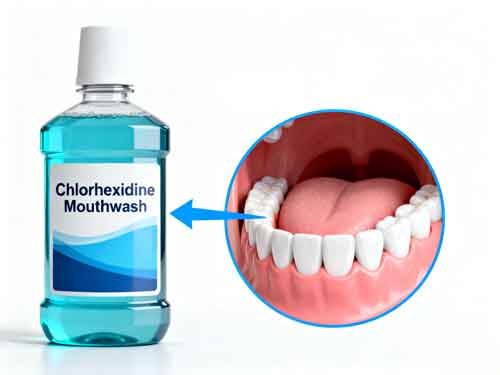
I. Chemical Nature and Mechanism of Action of Chlorhexidine
The antibacterial activity of chlorhexidine (1,6-bis(N1-p-chlorophenyl-N5-biguanidino)hexane) stems from its unique chemical structure and mode of action. It achieves a three-dimensional assault on biofilms through “anchoring – penetration – disruption.”
1.1 Electrostatic Anchoring Effect of the Biguanide Salt Structure
At physiological oral pH (5–7), chlorhexidine undergoes protonation of its biguanide group, forming a divalent cationic compound (pKa=8.3–8.4). Its positive charge strongly interacts electrostatically with the negatively charged phosphate groups in the phospholipid bilayer of oral bacterial cell membranes and with negatively charged groups (e.g., carboxyl and hydroxyl groups) in biofilm EPS polysaccharides, achieving “irreversible anchoring.” This process remains unaffected by biofilm thickness. Rapid adsorption occurs even on mature biofilms (thickness > 50μm), establishing the foundation for subsequent antibacterial activity.
1.2 Irreversible Inactivation Mechanism via Transmembrane Disruption
Anchored chlorhexidine molecules insert into the bacterial phospholipid bilayer via hydrophobic interactions, disrupting membrane structural integrity. This action increases membrane permeability, triggering rapid intracellular K+ leakage (in vitro studies show >60% K+ leakage within 30 minutes). Simultaneously, it inhibits ATPase activity on the cell membrane, blocking energy metabolism pathways. Ultimately, this leads to bacterial protein denaturation and irreversible inactivation.
This mechanism is effective against both Gram-positive bacteria (e.g., Streptococcus mutans) and Gram-negative bacteria (e.g., Porphyromonas gingivalis), with a minimum inhibitory concentration (MIC) as low as 0.002–0.01 mg/mL.
1.3 Structural Disruption of the Anti-Membrane Matrix
Chlorhexidine acts through hydrogen bonding and hydrophobic interactions. It penetrates the EPS polysaccharide network of biofilms, disrupting their cross-linked structure. After 24 hours of treatment with 0.12% CHX mouthwash, biofilm thickness decreased by 32.7%. EPS content reduced by 41.3%. This effectively exposes pathogens concealed within the matrix, enhances the penetration efficiency of antimicrobial agents, and prevents infection recurrence caused by residual bacteria within the biofilm.
II. Formulation Engineering Advantages
The industrial application of chlorhexidine relies on precise formulation engineering optimization. Its inherent limitations are addressed through dissolution strategies, pH control, compatibility optimization, and taste improvement.
2.1 Efficient Dissolution Strategies
Free chlorhexidine base exhibits extremely poor water solubility (<0.01g/100mL). Two core dissolution approaches are employed industrially.
Salt Conversion Method: Converting chlorhexidine into gluconate or acetate salts. A 20% chlorhexidine gluconate stock solution can be directly diluted with aqueous solutions to 0.12% (a commonly used clinical concentration). This process requires no organic solvents, resulting in low production costs and excellent biocompatibility.
Microemulsion solubilization method. A composite microemulsion system is constructed using hydroxypropyl cellulose (HPC) and polyethylene glycol 400 (PEG400). Chlorhexidine molecules are encapsulated via hydrogen bonding, achieving formulation clarity >95% (turbidity <5 NTU). No crystallization occurs after 7 days of storage at 0°C. This addresses winter transportation stability issues in northern regions.
2.2 Broad pH Stability Window
Oral care formulations must accommodate oral pH fluctuations (4.5–8.0). The chlorhexidine formulation employs a citrate buffer pair (citric acid–sodium citrate) to establish a stable pH window of 5.5–6.5. Within this range, chlorhexidine exhibits maximum protonation, with antimicrobial activity loss <5%. Accelerated testing at 25°C shows active ingredient degradation rate of only 1.8% over 28 days. In contrast, hypochlorous acid-based antimicrobial agents rapidly decompose at pH >8 (24-hour degradation rate >50%), demonstrating significantly inferior stability.
2.3 Overcoming Formulation Incompatibilities
Chlorhexidine’s cationic nature readily antagonizes anionic ingredients. Two major technical breakthroughs address this in formulation design.
Avoiding Anionic Surfactants: Sodium lauryl sulfate (SLS), commonly used in traditional toothpastes, forms insoluble complexes with chlorhexidine, reducing antimicrobial activity by 30%. Switching to the nonionic surfactant alkyl polyglycoside (APG08) improves compatibility. APG08 itself possesses weak antimicrobial properties, achieving synergistic enhancement.
Metal Ion Chelation Synergy. Adding 0.1% EDTA (ethylenediaminetetraacetic acid) chelates Ca2+ and Mg2+ on Gram-negative bacterial cell membranes, disrupting lipopolysaccharide (LPS) structure. This facilitates chlorhexidine penetration through cell membranes. Antibacterial activity against Escherichia coli and Porphyromonas gingivalis increased fourfold.
2.4 Taste Masking Technology
Chlorhexidine’s biguanide structure imparts a strong bitter taste (threshold concentration 0.005%). Improved through β-cyclodextrin inclusion complexing + flavor compounding technology. Forms an inclusion complex with 0.05% neohesperidin DC (dihydrochalcone sweetener) and 0.8% menthol. Masks bitterness while providing a cooling sensation.
III. Sustained Release and Mucosal Adsorption Properties
Chlorhexidine’s long-lasting antibacterial advantage stems from its slow release within the oral cavity and mucosal adsorption characteristics. Sustained protection exceeding 12 hours is achieved through three key technological pathways.
3.1 Positive-Negative Electrostatic Adsorption
The zeta potential on oral mucosal epithelial cell surfaces is -12 mV (at pH 6.8). This induces electrostatic adsorption with chlorhexidine cations, forming stable “mucosal-drug” complexes. Adsorption reaches 2.3 μg/cm2.
This complex slowly desorbs under saliva flushing. After 12 hours, chlorhexidine concentration in saliva remains at 0.015 mg/mL—exceeding the MIC90 (0.008–0.012 mg/mL) of most pathogenic bacteria. This achieves prolonged antibacterial efficacy.
3.2 Cross-linked Hydrogel Sustained Release
The formulation incorporates 0.1% Carbomer 974P (acrylic resin). Its carboxyl groups form a polyelectrolyte network with chlorhexidine cations via electrostatic interactions. This constructs a cross-linked hydrogel system that adheres to oral mucosa and tooth surfaces after rinsing. Two hours post-rinsing, chlorhexidine concentration in saliva remains at 62% of the immediate post-rinsing level, and 38% after 4 hours. This effectively prolongs the duration of action, overcoming the “rapid decline after an initial peak” limitation of traditional formulations.
3.3 Crystal Precipitation Technology
Employed a chlorhexidine-lauric acid ion pair system. By adjusting reaction temperature (45°C) and stirring speed (300 rpm), Nanoscale precipitation particles with a particle size of 200 nm were prepared. These particles exhibit hydrophobicity. After rinsing, they can be targeted to deposit on tooth surfaces (especially in cleaning dead zones such as fissures and interdental spaces). The deposition amount is 1.8 times higher than that of conventional formulations. Moreover, they slowly dissolve in the acidic environment of plaque formation, achieving “on-demand release.”
Conclusion
The success of chlorhexidine mouthwash stems from its molecular design featuring a cationic biguanide structure, precisely engineered formulation, sustained-release technology, and mature industrial production processes.
As a benchmark product for chemical control of oral biofilms, chlorhexidine mouthwash demonstrates irreplaceable value in both professional oral care (periodontal disease adjunct therapy, postoperative antimicrobial suppression) and public health applications (oral infection prevention).
Looking ahead, the integration of nanocarriers, smart response systems, and green chemistry will enable chlorhexidine mouthwash to transcend current limitations. It will achieve upgrades in targeting precision, environmental sustainability, and personalized applications, continuing to lead the technological evolution of oral antimicrobial products.