



Biocide Chemicals
Shandong IRO are famous for high-quality biocide
chemicals, professional service, experienced expert
and advanced technology.Biocides category as below:
aldehydes, halogens, hydantoins, isothiazolinones and
other environment-friendly biocides.
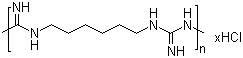
Polyhexamethylene Biguanide (PHMB)
CAS No.:
32289-58-0
Molecular Formula:
(C8H18N5Cl)n, n=12-16
Structure Formula:
Properties:
Polyhexamethylene Biguanide (PHMB) is a new, environment-friendly, cationic, water-soluble polymer. It is a water solution that can be used as a broad-spectrum, high-efficiency disinfectant. PHMB biocide is low toxic, stable, non-flammable, non-explosive, and basically non-corrosive to stainless steel, copper, carbon steel, wood, and plastic.
Because of its special bactericidal mechanism, almost all kinds of bacteria shall be killed efficiently and will not develop resistance action. PHMB disinfectant is a high molecular polymer which is easy to be washed away. It is non-corrosive to skin and can not be easily absorbed by human organs. In vitro studies show that Polyhexamethylene biguanide hydrochloride is non-toxic to human cells. Skin irritancy tests of rabbits and human hands show that PHMB is non-irritant to animal and human skin. Polyhexamethylene biguanide hydrochloride can be widely used in textile, animal husbandry, aquaculture, medical sterilization, and daily disinfectant.
Specifications:
| Item | Index | |
|---|---|---|
| Appearance | Colorless or light yellow liquid | Colorless or light yellow liquid |
| Active content | 20% Min. | 99% Min. |
| Ordor | None | Weak amine odor |
| pH (1% solution) | 4.0 Min. | 4.0 Min. |
| Density (g/ml, 20℃) | 1.040-1.050 | — |
| Absorbance (1%, 236nm) (1%,236nm) | 400 Min. | 0.03 |
| Absorbance (236/220nm) | 1.2-1.6 | 1.2-1.6 |
| Moisture | — | 0.5% Max. |
| Water insoluable | — | 0.1% |
| Ash | — | 0.05% |
| Water solubility | Complete | Complete |
Features:
- Bactericidal Spectrum: Broad-spectrum, capable of killing/inhibiting various types of microorganisms.
- Drug Resistance: Microorganisms do not develop drug resistance (mutations do not affect bactericidal efficacy).
- Solubility: Easily soluble in water to form a tasteless, colorless and transparent solution.
- Metal Compatibility: Non-corrosive to copper, stainless steel, carbon steel and other metals.
- Textile Compatibility: Does not affect the main properties of textiles, and has high bonding strength with cotton fibers.
Sterilization mechanism:
- Electrostatic Adsorption and Inactivation: The highly active guanidine group and cationic nature of the polymer adsorb anionic bacteria/viruses, preventing their division and reproduction and leading to their inactivation.
- Cell Membrane Destruction: Disrupts the cell membrane structure and forms transmembrane pores, resulting in cell membrane rupture, interfering with the energy metabolism of organisms and inactivating bacteria/viruses.
- Suffocation: The polymer forms a film that blocks the respiratory channels of microorganisms, causing them to suffocate and die.
The sterilization mechanism is independent of the form and type of microorganisms. Even if the microorganisms mutate, the mutation will not affect its efficacy. Microorganisms do not produce resistance to PHMB.
Applications:
Polyhexamethylene biguanide hydrochloride (PHMB) can completely kill Escherichia coli, Staphylococcus aureus, Candida albicans, gonococcus, salmonella, Pseudomonas aeruginosa, Listeria, dysentery, Aspergillus niger, Brucella, Vibrio parahaemolyticus, Vibrio algolyticus, Vibrio eels, Aeromonas hydrophilic, sulfate-reducing bacteria, iron bacteria, and saprophytic bacteria. It is suitable for care solutions for contact lenses, cosmetics, medical, pharmaceutical, skin, mucosa, vegetables, fruits, air, drinking water, swimming pools, paper making, tissue, sanitary pads, clothes, etc.
1. Disinfectant detergent for fruits and vegetables
After a lot of screening and comparison, the main active ingredients and auxiliary components of disinfectant detergents for fruits and vegetables have been fully studied. On this basis, PHMB disinfectant was selected.
Polyhexamethylene Biguanide Hydrochloride is the main component of the fruit and vegetable disinfectant detergent. It has the advantages of reliable sterilization effect, environmental protection, good stability and use. And can be used in high dilution, is economic and cost-effective, and conducive to the promotion of use.
In addition, PHMB and chlorhexidine acetate are the main components of poly hexamethylene biguanide hydrochloride compound disinfectant. It also has a good bactericidal effect on the natural bacteria on the surface of fruits and vegetables. Its average logarithmic value of killing natural bacteria on the surface of cucumber, apple, grape, and strawberry all reached above 2.08.
2. Antimicrobial finishing agent for fabrics
PHMB antimicrobial with dip-rolling, impregnation, method, or spray method to treat cotton and its blended fabrics after dyeing or printing. It can effectively inhibit the growth of bacteria. Its antibacterial properties remain effective after 10~100 washes at 50℃.
PHMB Antimicrobial does not affect the main properties of textiles. It is suitable for use on most cotton fiber products.
PHMB disinfectant is a cationic oligomer. Its distribution is said to be 2 to 40 biguanide units. Each biguanide unit has 2 cationic groups. The high molecular weight polyhexamethylene biguanide hydrochloride can form multiple adsorption points with the fiber surface, and the binding strength is high.
3. Used in contact lens care solution and female lotion
At present, PHMB and PAP are the main active ingredients in contact lens care solutions. They can recognize the phospholipid receptors on the surface of pathogenic microorganisms. Thus, they can selectively destroy the cell membrane of pathogenic microorganisms and kill the pathogens. BIGUANIDE antiseptic is less irritating and more effective, and can be used as the main component of female lotion.
Dosage:
- As a single disinfectant: Recommended dosage of 100~500 mg/L.
- Water treatment: Usually formulated with other water treatment chemicals, dosage adjusted according to water quality and equipment conditions.
- Textile printing and dyeing/animal husbandry/aquaculture: Dosage determined by specific processes and methods.
Packing and Storage:
- Storage Environment: Store in a cool, dry and well-ventilated warehouse, away from fire and heat sources, and avoid direct sunlight.
- Packaging Requirements: Sealed packaging to prevent moisture.
- Storage Isolation: Store separately from oxidants, flammable and combustible materials.