



Table of Content
- Structure Determines Reaction
- Nucleophilic Addition
- Redox Reactions
- Condensation with Amines
- Synthetic Strategies and Natural Examples in Biological Systems
- Industrial Applications and New Directions in Green Synthesis
- Conclusion
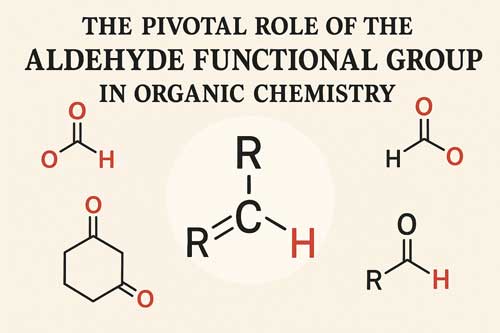
The aldehyde functional group (general structural formula R–CHO) stands as one of the most strategically significant oxygen-containing functional groups in organic chemistry. Its defining characteristic lies in the unique structure where the carbonyl carbon is directly bonded to hydrogen, endowing the carbonyl carbon with dual chemical properties: pronounced electrophilicity and susceptibility to oxidation. The synergistic interaction between this structure and its electronic properties positions the aldehyde group as a pivotal hub connecting diverse functional group transformations. The aldehyde functional group stands as a “chemical crossroads” in organic synthesis, biological metabolism, and industrial production.
I. Structure Determines Reaction
The carbonyl carbon atom in the aldehyde group adopts sp2 hybridization, forming a planar triangular configuration. The π electron cloud of the C=O double bond shifts toward the oxygen end due to oxygen’s high electronegativity, imparting a partial positive charge (δ+) to the carbonyl carbon. This electron distribution not only makes the carbonyl carbon’s π* orbital a target for nucleophilic attack it establishes the structural foundation for nucleophilic addition reactions. Moreover, the hydrogen atoms directly bonded to the aldehyde carbon exhibit weak acidity and reducing properties, providing a unique site for oxidation reactions.
The planar configuration resulting from sp2 hybridization reduces steric hindrance. This enables nucleophilic addition and redox reactions to become the two core pathways for aldehyde chemistry, laying the molecular foundation for its multifunctional transformations.
II. Nucleophilic Addition
Nucleophilic addition reactions serve as key pathways for aldehyde-based carbon chain extension and functional group diversification. Hydrolysis following addition of Grignard reagents (RMgX) to aldehydes efficiently constructs primary or secondary alcohols, representing a classic method for synthesizing complex carbon skeletons. The Wittig reaction achieves direct conversion of the carbonyl group into a carbon-carbon double bond through nucleophilic elimination of phosphorylidene with aldehydes. This achieves the alkylation of carbonyl groups and finds extensive application in natural product synthesis.
Aldol condensation, driven by the activation of the aldehyde’s own α-hydrogen, proceeds via nucleophilic addition to form β-hydroxyaldehydes. Subsequent dehydration yields α,β-unsaturated carbonyl compounds, providing an efficient strategy for building conjugated systems and extending carbon chains.
These reactions center on the electrophilicity of the aldehyde group, enabling directed transformations from aldehydes to alcohols, alkenes, and unsaturated carbonyl compounds. They serve as core tools for carbon chain extension in organic synthesis.
III. Redox Reactions
Redox reactions involving aldehyde groups establish a transformative bridge for functional group “upgrading” and “downgrading,” combining mildness with selectivity.
In oxidation reactions, mild oxidants like Tollens’ reagent induce the silver mirror reaction in aldehydes, while strong oxidants such as potassium permanganate (KMnO4) or chromic acid (PCC) quantitatively convert them into carboxylic acids. Notably, the Tollens’ reagent test serves as a characteristic identification method for distinguishing aldehydes from ketones.
In reduction reactions, sodium borohydride (NaBH4) serves as a mild reducing agent, capable of reducing aldehyde groups to primary alcohols in aqueous or alcoholic solutions without affecting other functional groups. Lithium aluminum hydride (LiAlH4), meanwhile, achieves strong reductive conversion in anhydrous ether solvents, also efficiently yielding primary alcohols. The complementary nature of oxidation and reduction reactions enables the aldehyde group to flexibly switch between different oxidation states, such as alcohols and carboxylic acids, serving as a crucial bridge for functional group transformations.
IV. Condensation with Amines
The condensation reaction between aldehyde groups and amine compounds is a core strategy for introducing nitrogen atoms in organic synthesis. The reaction between aldehydes and primary amines (R–NH2) yields imines (Schiff bases). This reaction is reversible. Catalytic hydrogenation enables reductive amination. Efficient preparation of secondary amines is a common method for modifying amino structures in drug molecules.
The Strecker reaction employs aldehydes, amines, and sodium cyanide as starting materials. Through nucleophilic addition of the imine intermediate, it enables one-step construction of α-amino acid skeletons, providing a concise pathway for synthesizing bioactive molecules.
Additionally, the condensation reaction between aldehydes and diamines can be employed for constructing heterocyclic compounds. For instance, it enables the synthesis of nitrogen-containing heterocycles like imidazole and pyridine, serving as a crucial synthetic building block in heterocyclic chemistry. This highlights the pivotal role of the aldehyde group as a key stepping stone for nitrogen atom introduction and heterocyclic construction.
V. Synthetic Strategies and Natural Examples in Biological Systems
The multifunctionality of aldehyde groups has driven the development of efficient synthetic strategies. Techniques such as aldehyde protection and deprotection (commonly achieved via acetalization for protection and acid-mediated deprotection) address selectivity challenges in synthesizing multifunctional molecules.
Multi-component one-pot reactions (e.g., the Ugi reaction) utilize aldehydes as core substrates. These enable one-step assembly of multifunctional groups, significantly enhancing synthetic efficiency. Within biological systems, the open-chain structures of monosaccharides like glucose contain aldehyde groups, participating in glycogen synthesis and metabolic reactions. Retinal, the active form of vitamin A, facilitates visual signal transduction through structural isomerization of its aldehyde group. These serve as natural exemplars of aldehyde functionality in life processes.
VI. Industrial Applications and New Directions in Green Synthesis
Aldehyde groups hold an irreplaceable position in industrial production. Formaldehyde, as a core raw material, is used to synthesize polymeric materials such as phenolic resins and urea-formaldehyde resins. Acetaldehyde, through catalytic oxidation, is converted into acetic acid, forming a vital industrial chain in organic chemistry. Aldehyde-containing compounds like vanillin and citral, valued for their distinctive aromas, serve as core products in the fragrance industry.
In recent years, green synthesis technologies have driven the transformation and upgrading of aldehyde-based processes. Methods like TEMPO-catalyzed oxidation and photocatalytic oxidation have enabled milder and more environmentally friendly aldehyde conversions. These advancements reduce energy consumption and pollution associated with traditional processes, enhancing the sustainability of industrial applications for aldehyde-based compounds.
VII. Conclusion
The aldehyde functional group, with its unique structure and electronic properties, integrates core reactions such as nucleophilic addition, redox processes, and amine condensation. It constructs a transformation network connecting diverse functional groups including alcohols, acids, alkenes, and amines.
As a pivotal hub in organic synthesis, the aldehyde functional group serves as both a core intermediate in laboratory synthesis and a key participant in biological metabolism, while also functioning as a vital raw material for industrial production. It has become a shared nexus spanning synthetic chemistry, life sciences, and industrial technology. Its multifunctional transformation properties continue to expand the boundaries of organic chemistry applications.