




Glutaraldehyde is an indispensable key chemical in the fields of medical disinfection, dental therapy, vaccine manufacturing, and biological research. As a typical saturated dialdehyde compound, it exhibits unique chemical reactivity and biocompatibility, making it a core raw material and auxiliary reagent in modern biomedicine, pharmaceutical industry, and industrial production.
This guide systematically elaborates on the basic properties, preparation methods, and application fields of glutaraldehyde, focusing on its specific application scenarios in dentistry, vaccine production, tissue fixation, and industrial processes, to provide professional and comprehensive technical reference for chemical professionals, medical researchers, and related industry practitioners.
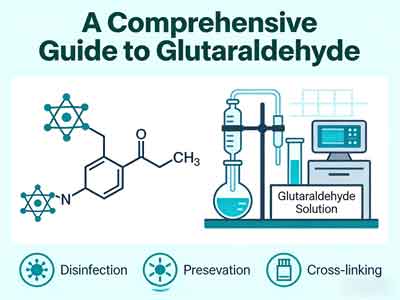
What is glutaraldehyde?
Glutaraldehyde, a saturated dialdehyde compound with the chemical formula C5H8O2, exists as a colorless to pale yellow transparent liquid at ambient temperature, accompanied by a mild pungent odor. Its molecular structure contains two aldehyde groups (-CHO) at the terminal positions, which endow it with high chemical reactivity—specifically, it can form stable covalent bonds with functional groups (such as amino, sulfhydryl, and hydroxyl groups) of biomacromolecules including proteins and nucleic acids. This unique reactivity lays the foundation for its wide application in sterilization, biological sample fixation, and material modification.
As a high-efficiency broad-spectrum disinfectant and reliable biological fixative, glutaraldehyde plays an irreplaceable role in modern biomedicine, pharmaceutical synthesis, and industrial production, and is recognized as a key basic chemical in related fields.
What are the uses of glutaraldehyde?
The core application value of glutaraldehyde originates from its strong bactericidal activity and specific protein cross-linking property. Its main application fields are as follows.
Medical disinfection: As a high-level disinfectant, it is widely used for the sterilization of heat-sensitive medical devices (such as endoscopes, minimally invasive surgical instruments, and dental handpieces). It can effectively inactivate various pathogenic microorganisms, including bacteria, viruses, fungi, and bacterial spores, ensuring the safety of medical procedures.
Biological Specimen Fixation: In the fields of histology, pathology, and electron microscopy, glutaraldehyde is used as a core tissue fixative to quickly penetrate biological tissues and cells, inducing protein denaturation and cross-linking, thereby preserving the ultrastructural integrity of tissues and cells for subsequent experimental analysis and detection.
Industrial Applications: It is used as a sterilant, preservative, and cross-linking agent in industries such as leather tanning, petroleum extraction, and water treatment. Additionally, it serves as a key monomer in the synthesis of polymeric materials, adhesives, and resin products, improving the mechanical properties and stability of the products.
Pharmaceutical Sector: In vaccine production, it acts as an inactivator and antigen cross-linking agent; in drug formulation, it is used as an excipient to improve the stability and bioavailability of drugs.
What are the uses of glutaraldehyde in dentistry?
In dental clinical practice, glutaraldehyde is a key reagent for root canal therapy and instrument disinfection, with the following specific applications.
Root canal disinfection: It is used for the sterilization of root canal canals during root canal therapy, effectively eliminating residual pathogenic bacteria in the root canal system, reducing the recurrence rate of periapical infection, and improving the success rate of therapy.
Dentin Desensitization: By forming cross-linking bonds with collagen fibers in dentin, it seals the dentinal tubules, reduces the permeability of dentin, and thereby alleviates tooth sensitivity caused by external stimulation.
Instrument Sterilization: For heat-sensitive dental instruments (such as handpieces, reamers, and explorers), glutaraldehyde soaking sterilization is adopted to ensure the sterility of instruments and avoid cross-infection during clinical operations.
The commonly used concentration of glutaraldehyde in dental clinical practice is 2%, and strict compliance with operational specifications is required during use to avoid potential hazards caused by reagent contact with skin and mucous membranes.
What is glutaraldehyde made from?
In industrial production, glutaraldehyde is mainly synthesized through two mature technological routes, both of which can meet the quality requirements of pharmaceutical and industrial grade products.
Acrolein route: With acrolein and vinyl ether as raw materials, glutaraldehyde is produced through addition reaction, cyclization reaction, and hydrolysis reaction. This route has the advantages of mature technology, low raw material cost, and high production efficiency.
1,5-Pentanediol oxidation method: With 1,5-pentanediol as the raw material, high-purity glutaraldehyde is prepared through catalytic oxidation reaction under the action of a metal catalyst. This route has the characteristics of high product purity, few by-products, and environmental friendliness.
Both synthesis routes can stably produce glutaraldehyde products that meet the relevant national standards for pharmaceuticals and industry, and are widely used in industrial production.
What are the uses of glutaraldehyde solution?
Glutaraldehyde is mainly used in the form of aqueous solution in actual applications, and different concentrations correspond to different application scenarios, specifically as follows.
2% alkaline glutaraldehyde solution: It is the most widely used medical device disinfectant, mainly used for the sterilization of heat-sensitive medical instruments such as endoscopes and laparoscopic instruments, with a sterilization efficiency of more than 99.9%.
0.1%–0.5% solution: It is used for the fixation of histological specimens and cell samples, which can effectively preserve the ultrastructure of cells and tissues, providing a reliable basis for subsequent experimental detection.
High-concentration solutions (>50%): It is used as an industrial raw material, mainly for the synthesis of resins, leather tanning, and water treatment, and can also be used as a cross-linking agent for polymer materials.
Note: Glutaraldehyde solution has strong irritation to skin and mucous membranes. Operators must wear protective equipment during use, and avoid direct contact with the reagent.
What is glutaraldehyde in vaccines?
In the process of vaccine production, glutaraldehyde plays a key role as an inactivator and antigen stabilizer, and its specific functions are as follows.
Inactivating viruses: By covalently binding to the amino groups of viral capsid proteins, glutaraldehyde destroys the spatial structure of viral proteins, thereby inactivating the infectivity of viruses while retaining the antigenicity of viruses. It is widely used in the production of inactivated vaccines, such as influenza inactivated vaccines and polio inactivated vaccines.
Protein cross-linking: It can cross-link the antigen molecules in the vaccine, improve the stability of the antigen, enhance the immunogenicity of the vaccine, and extend the shelf life of the vaccine product.
In modern vaccine production, the residue of glutaraldehyde is strictly controlled, and the residue content must meet the national pharmaceutical safety standards to ensure the safety and effectiveness of the vaccine.
What is glutaraldehyde in urine?
The glutaraldehyde detected in urine is mainly derived from endogenous metabolism and exogenous exposure, and its content is closely related to the exposure route and metabolic status.
Endogenous metabolism: Trace amounts of glutaraldehyde can be produced during the metabolic process of certain drugs (such as chloral hydrate) in the human body, which is then excreted in the urine.
Exogenous exposure: For workers engaged in medical disinfection, industrial production, and laboratory operations, long-term exposure to glutaraldehyde may lead to the absorption of glutaraldehyde and its metabolites into the body, which are then excreted through the urinary system.
The abnormal increase of glutaraldehyde content in urine needs to be combined with clinical context for analysis, which may indicate occupational exposure to glutaraldehyde or the use of specific metabolic drugs.
What is glutaraldehyde fixative?
Glutaraldehyde fixative is one of the most commonly used tissue fixatives in biomedical research and clinical pathology, with the following core functions.
Rapid fixation: It has strong penetration and can quickly penetrate into biological tissues and cells, inducing the denaturation and coagulation of proteins in cells, thereby preventing cell autolysis and tissue decay, and maintaining the original structure of tissues and cells.
Structural preservation: Through the cross-linking effect with proteins and nucleic acids, it can effectively preserve the ultrastructure of cells (such as cell membranes, organelles, and chromatin), which is a key pretreatment step for electron microscopy observation and histological detection.
The standard concentration of glutaraldehyde fixative used in laboratory research is 2.5%, and it is often used in combination with formaldehyde fixative to optimize the fixation effect and improve the stability of biological samples.
What is the cross-linking effect of glutaraldehyde?
The cross-linking effect of glutaraldehyde refers to the chemical reaction process in which its two terminal aldehyde groups react with functional groups (such as amino, sulfhydryl, and hydroxyl groups) on biomolecules (such as proteins, collagen, and nucleic acids) to form covalent bonds, thereby connecting adjacent molecular chains to form a three-dimensional network structure. This property gives glutaraldehyde important application value in the following fields.
Material Modification: In the preparation of biomaterials (such as artificial heart valves, surgical sutures, and tissue engineering scaffolds), glutaraldehyde cross-linking can significantly improve the mechanical strength, chemical stability, and biocompatibility of the materials, extending the service life of the biomaterials in the human body.
Enzyme Immobilization: By cross-linking enzyme molecules with carriers, the stability of enzymes can be improved, the loss of enzymes can be reduced, and the reusability of enzymes can be enhanced, which is widely used in the fields of biocatalysis and biosensor preparation.
Tissue Engineering: It is used to cross-link biological macromolecules (such as collagen and gelatin) to construct three-dimensional scaffolds that simulate the extracellular matrix, which can provide a suitable growth environment for cells and promote tissue regeneration and repair.
Conclusion.
Glutaraldehyde is a multi-functional key chemical with unique chemical properties and wide application fields. It plays an irreplaceable role in medical disinfection, biological research, pharmaceutical production, and industrial manufacturing.
For chemical professionals and related industry practitioners, a comprehensive understanding of the properties and applications of glutaraldehyde is of great significance for optimizing application processes, ensuring product quality, and improving operational safety.