




Glutaraldehyde is a high-level disinfectant and sterilant that is effective against bacterial vegetative cells, bacterial spores, fungi, and viruses. It is commonly used for the disinfection and sterilization of clinical endoscopes. During the disinfection of hospital endoscopes with glutaraldehyde, the effective concentration gradually decreases due to dilution and consumption.
Accurately determining the glutaraldehyde content in disinfectant products to ensure their disinfecting efficacy is a common challenge encountered in market spot checks.
Glutaraldehyde disinfectants do not contain glutaraldehyde as the sole active ingredient; most are new-generation glutaraldehyde-based composite disinfectants. While these formulations improve the disinfecting performance of glutaraldehyde disinfectants, they also pose challenges for content determination.
The triethanolamine-hydroxylamine hydrochloride titration method is the most widely used official method for determining the glutaraldehyde content in disinfectants. However, this titration method is subject to interference from many factors when used to determine the content of compound glutaraldehyde disinfectants. Consequently, many researchers have proposed the use of instrumental analytical methods.
In this study, glutaraldehyde content in both single-component and compound glutaraldehyde disinfectants was determined using titration, spectrophotometry, and high-performance liquid chromatography (HPLC), respectively. The advantages and disadvantages of these three detection methods were compared. A one-way analysis of variance (ANOVA) was conducted to assess the variability in the measurement results. This study provides technical guidance for the appropriate selection of methods for determining glutaraldehyde content in disinfectants.
1. Materials and Methods
1. 1 Test Materials
Analytical instruments include the UV1901 UV-Vis spectrophotometer; the LC-20A ultra-high-performance liquid chromatograph; the BSA124S electronic balance; a Milli-Q Direct water purifier. Analytical reagents include glutaraldehyde standard solution (500 g/L aqueous solution); 2,4-dinitrophenylhydrazine, chromatographic grade; triethanolamine, bromophenol blue, hydroxylamine hydrochloride, etc.
1. 2 Test Methods
1. 2. 1 Titration Method: Hydroxylamine Hydrochloride Titration.
Before the determination, adjust the pH of the glutaraldehyde disinfectant to neutral (pH = 7.0). Carefully pipette an appropriate amount of the sample and place it in an iodometric flask. Accurately add 20.0 mL of triethanolamine solution and 25 mL of neutral hydroxylamine hydrochloride solution. Allow to stand for 1 hour, then titrate with 0.25 mol/L sulfuric acid titrant. Record the volume of sulfuric acid titrant used when the solution turns blue-green. Conduct a blank control test simultaneously to calculate the glutaraldehyde content in the sample.
1. 2. 2 Spectrophotometric Method
Plot a calibration curve with the mass concentration of glutaraldehyde in the standard series of solutions on the x-axis and the corresponding absorbance values on the y-axis. Based on the glutaraldehyde content labeled on the glutaraldehyde disinfectant, dilute the disinfectant with purified water to bring the glutaraldehyde concentration within the linear range of the calibration curve. Measure the absorbance at the characteristic absorption wavelength of 235 nm. Calculate the glutaraldehyde content in the sample based on the calibration curve.
1. 2. 3 Liquid Chromatography
(1) Preparation of derivatization reagent: Accurately weigh 1.0 g of 2,4-dinitrophenylhydrazine, dissolve it in acetonitrile, and dilute to volume in a 250 mL volumetric flask. Mix a 4 g/L acetonitrile solution of 2,4-dinitrophenylhydrazine with a 15 g/L aqueous solution of sodium dihydrogen phosphate in a 1:1 volume ratio, then adjust the pH of the solution to 2.0 with phosphoric acid to serve as the derivatization reagent for glutaraldehyde.
(2) Chromatographic conditions: Column (XDB C18 column, 4.6 × 250 mm, 5 μm); mobile phase (acetonitrile/phosphoric acid aqueous solution = 85/15, v/v); flow rate: 1.0 mL/min; Column temperature: 35°C; Detection wavelength: 360 nm; Injection volume: 10 μL.
(3) Sample Analysis: A 500 g/L glutaraldehyde solution was serially diluted with acetonitrile to appropriate concentrations to prepare a series of standard solutions. Mix 5 mL of each standard working solution with 5 mL of derivatization reagent, allow to react at a constant temperature of 40°C for 30 min, filter through a 0.45 μm nylon membrane, and then analyze using the instrument.
Plot a calibration curve with the mass concentration of glutaraldehyde in the standard series on the x-axis and the corresponding chromatographic peak area on the y-axis; the linear correlation coefficient should be no less than 0.995. Dilute the sample with acetonitrile to fall within the linear range of the calibration curve. Follow the same derivatization procedure as for the standard series, filter through a membrane, and analyze the sample on the instrument. Calculate the glutaraldehyde content in the sample based on the calibration equation of the calibration curve.
2. Results
2.1 Comparison of Detection Methods
Following the procedures for titrimetric analysis, calculate the limit of detection for glutaraldehyde using the titrimetric method. Measure the absorbance of a glutaraldehyde single-component sample solution at 0.005, calculate the three-fold standard deviation of the results from 11 determinations, and divide it by the slope of the calibration curve to obtain the limit of detection for the spectrophotometric method. For the HPLC method, the standard dilution method was used, and the detection limit was determined based on a signal-to-noise ratio of 3. The linear ranges and detection limits of the standard curves for the three detection methods are shown in Table 1.
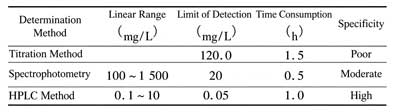
Table 1. Comparison of Results from Three Methods for Determining Glutaraldehyde Content
The matrix of composite glutaraldehyde disinfectant samples is relatively complex, and other components may interfere with the analysis. When selecting a detection method, the method’s specificity is of paramount importance. Titration and spectrophotometric methods are nonspecific; alkaline substances and other aldehyde-containing organic compounds present in the disinfectant can generate interfering signals, causing significant positive interference. In contrast, chromatographic analysis separates the target compound from the matrix before determining its concentration, thereby reducing interference from impurities; it offers superior selectivity and sensitivity compared to titration and spectrophotometric methods. Figure 1 shows the liquid chromatogram of glutaraldehyde disinfectant after the addition of another bactericide, chloroacetaldehyde, following reaction with a derivatizing agent.
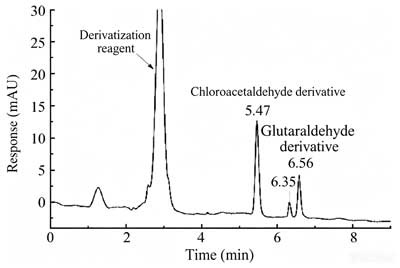
Figure 1. Determination of Chloroacetaldehyde in Glutaraldehyde Disinfectants by Liquid Chromatography
2. 2 Comparison of Test Results
2. 2. 1 Comparison of Test Results for a Single-Formulation Glutaraldehyde Disinfectant.
Three parallel samples of the single-formulation glutaraldehyde disinfectant were prepared, and the glutaraldehyde content was determined using titration, spectrophotometry, and HPLC, respectively. The results showed that the measurements obtained by the three methods were generally consistent, with relative deviations of less than 5%. The spiked recovery rates ranged from 95% to 105%, indicating that all three methods are suitable for the analysis of single-formula glutaraldehyde disinfectants (Table 2).
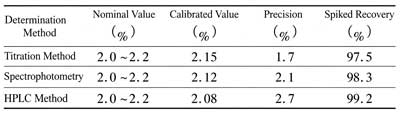
Table 2. Results of Spiked Recovery Tests Using Three Methods on Samples of a Single-Formula Glutaraldehyde Disinfectant
2. 2. 2 Comparison of Test Results for Compound Glutaraldehyde Disinfectants.
The glutaraldehyde content in the compound glutaraldehyde disinfectant sample was determined according to the steps described above; this compound disinfectant sample contained 5.0% glutaraldehyde. The test results show that, compared with the titration and spectrophotometric methods, the HPLC method yielded results that were essentially consistent with the sample’s calibrated value of 5.07%, demonstrating high accuracy (Table 3).
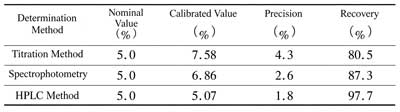
Table 3. Spiked Recovery Tests for Composite Glutaraldehyde Disinfectant Samples
3. Discussion
Currently, the main methods used to determine the active ingredient content in glutaraldehyde disinfectant products include titration, spectrophotometry, and liquid chromatography.
The titration method utilizes the principle of acid-base neutralization. It involves reacting glutaraldehyde with a triethanolamine solution, using a neutral hydroxylamine hydrochloride solution of bromophenol blue as an indicator, and titrating the remaining triethanolamine solution with a standard sulfuric acid solution. The glutaraldehyde content is then calculated based on the volume of standard sulfuric acid solution consumed. The advantage of this method is that it does not require expensive detection equipment and is easy to implement. However, titration has the following disadvantages:
(1) Poor precision of the test results, because the titration reaction takes place under neutral conditions, while the color change range of bromophenol blue is pH 3.0–4.6; the titration endpoint is difficult to determine, leading to reading errors;
(2) The analysis takes a long time; it takes at least 1 hour for glutaraldehyde to react completely with the triethanolamine solution;
(3) It has poor resistance to interference; the measured glutaraldehyde content can be affected by the pH of the glutaraldehyde solution, alkaline buffers, and sodium nitrite rust inhibitors, among other factors, which compromise the accuracy of the results.
Glutaraldehyde has a characteristic absorption peak at a wavelength of 235 nm; its absorption intensity is directly proportional to the concentration of glutaraldehyde, thereby enabling the development of a spectrophotometric method for determining its concentration. This method for determining glutaraldehyde in disinfectants offers the advantages of simplicity, speed, and accuracy, making it suitable for rapid testing. However, glutaraldehyde has a low molar absorption coefficient, resulting in low detection sensitivity; the method’s detection limit is only 20–50 mg/L. Furthermore, the detection wavelength of 235 nm is close to the vacuum ultraviolet region, where most organic compounds exhibit absorption, leading to poor specificity of the method. Glutaraldehyde can produce specific light absorption after derivatization with certain organic compounds. By derivatizing glutaraldehyde and using a dual-wavelength spectrophotometric method to determine its concentration—with selected derivatizing agents including p-aminobenzenesulfonic acid⁴ -nitroaniline, among others. Although detection sensitivity and resistance to interference have improved, this method still cannot eliminate interference from other aldehydes.
There are two methods for determining glutaraldehyde by high-performance liquid chromatography (HPLC): the direct method and the derivatization method. The direct method involves separating glutaraldehyde using a C18 column and determining its concentration at the characteristic wavelength of 235 nm. However, the aldehyde group of glutaraldehyde has a certain degree of polarity, resulting in weak retention on the C18 column. Additionally, hydrogen bonding easily occurs between the aldehyde group and the residual silanol groups on the C18 column’s stationary phase, leading to poor peak shape.
Currently, high-performance liquid chromatography (HPLC) for glutaraldehyde primarily relies on the reaction between glutaraldehyde and 2,4-dinitrobenzohydrazide to form glutaraldehyde hydrazone, which has maximum absorption at 360 nm, thereby enabling the sensitive determination of trace glutaraldehyde residues. A drawback of this method is that the derivatization step is relatively complex and requires a high level of skill from the operator. HPLC analysis results indicate that, under the separation conditions of a C18 column, after reaction with the derivatizing agent, the two isomers—chloroacetaldehyde (5.47 min) and glutaraldehyde (6. 35 min and 6.56 min) were baseline-separated. The chloroacetaldehyde added as a disinfectant did not interfere with the determination of glutaraldehyde. Liquid chromatography allows for the precise quantification of glutaraldehyde in mixtures; however, when using titration or spectrophotometric methods, chloroacetaldehyde causes positive interference, resulting in higher-than-actual test results. LC exhibits higher specificity than titration and spectrophotometric methods, and the method demonstrates good selectivity.
Furthermore, after the aldehyde reacts with the 2,4-dinitrobenzohydrazide derivatizing agent, the molar extinction coefficient of the resulting benzaldehyde hydrazone is significantly enhanced, thereby lowering the method’s limit of detection. The selectivity and sensitivity of the liquid chromatography method are superior to those of titration and spectrophotometry, making it suitable for the detection of glutaraldehyde in complex systems and at trace levels.
In routine analysis of glutaraldehyde disinfectants, the concentration of glutaraldehyde in the disinfectant solution is generally high, so there is no need for an excessively high detection limit. Titration and spectrophotometric methods are widely used because the instruments are inexpensive and the procedures are simple.